You sent a great cold email. Then nothing.
It's tempting to think they weren't interested. But most of the time, they were just busy. Your email got buried under fifty others before lunch.
That's why the follow up matters so much. It's often the second, third or fourth email that gets the reply.
In this guide, you'll learn when to follow up, what to say, five templates you can copy and how to put the whole thing on autopilot with Outrich.
Why Follow Ups Work
People don't ignore you because they hate your offer. They ignore you because life gets in the way.
A meeting runs long. The inbox fills up. They mean to reply later and forget.
A polite follow up brings you back to the top of the inbox at a better moment. Each one is another chance to catch them on a good day.
And here's the thing. Most people never follow up at all. Simply sending a second email puts you ahead of a lot of your competition.
How Many Follow Ups Should You Send?
Three to five follow ups after your first email works well for most B2B outreach.
Fewer than that and you leave replies on the table. Many more and you start to annoy people and hurt your sender reputation.
The key is spacing. Give each email room to breathe, and make every one add something new.
The Best Follow Up Timing
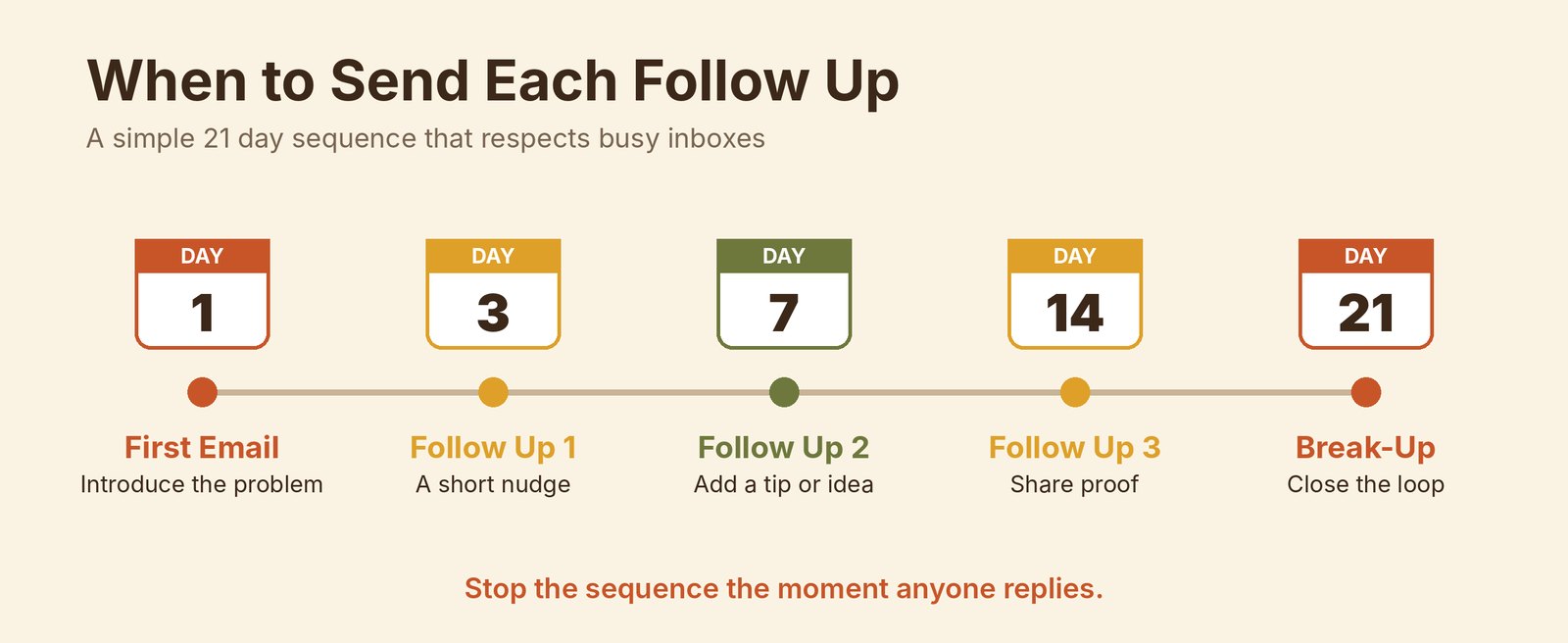
Here's a simple schedule that respects people's time.
| When | Goal | |
|---|---|---|
| First email | Day 1 | Introduce yourself and the problem you solve |
| Follow up 1 | Day 3 | A short, friendly nudge |
| Follow up 2 | Day 7 | Add value with a tip, idea or example |
| Follow up 3 | Day 14 | Share proof, like a result or case story |
| Break-up email | Day 21 | Close the loop politely |
Send on weekdays, during business hours in your prospect's time zone. Tuesday to Thursday mornings tend to be quieter inbox moments.
7 Rules for Follow Ups That Get Replies
1. Keep it short. Two to four sentences is plenty. Busy people reply to emails they can read in ten seconds.
2. Reply in the same thread. It keeps context and looks more personal than a brand-new email.
3. Add something new every time. A tip, a link, a quick idea or a result. Never just "bumping this up."
4. Make it about them. Mention their company, their goal or something they posted. Skip the long paragraphs about you.
5. Ask one easy question. "Worth a quick chat?" is easier to answer than "Let me know your thoughts."
6. Stay friendly, never guilty. No "I've emailed you five times." Keep the tone light and helpful.
7. Stop when they reply. If someone answers, even with a no, pull them out of the sequence right away.
5 Cold Email Follow Up Templates
Copy these, then make them your own. Swap in your prospect's name, company and details.
Template 1. The Gentle Nudge (Day 3)
Subject. Re your original subject
Hi {Name}, just floating this back to the top of your inbox in case it got buried. Would a quick 15 minute call next week make sense?
Template 2. The Value Add (Day 7)
Subject. A quick idea for {Company}
Hi {Name}, I was looking at {Company}'s website and noticed {specific detail}. One small change we often suggest is {simple tip}. Happy to share a few more ideas if that's useful.
Template 3. The Proof (Day 14)
Subject. How {Similar Company} did it
Hi {Name}, we recently helped {Similar Company} {short result}. I think {Company} could see something similar. Want me to send over a two minute summary?
Template 4. The Easy Question
Subject. Right person?
Hi {Name}, are you the best person to talk to about {topic} at {Company}? If not, could you point me to the right person? Thanks either way.
Template 5. The Break-Up (Day 21)
Subject. Should I close your file?
Hi {Name}, I haven't heard back, so I'll assume the timing isn't right. I won't reach out again about this. If things change, just reply to this email and I'll be happy to help.
The break-up email often gets the most replies of all. People respond to a polite, final message, even if only to say "not now."
Follow Ups for Other Situations
Cold outreach isn't the only time you need a good follow up. Here are short scripts for other moments that often go quiet.
After a Meeting No-Show
Hi {Name}, looks like we missed each other today. No worries at all, I know how busy things get. Here's my calendar link if you'd like to pick a new time.
After Sending a Proposal
Hi {Name}, just checking that the proposal reached you. Happy to walk through any part of it, or adjust the scope if something doesn't fit. What would be most helpful?
After a Good Call
Hi {Name}, thanks again for the chat today. As promised, here's {resource}. The next step we discussed was {step}. Does {day} still work for you?
After an Event or Webinar
Hi {Name}, great to see you at {event}. You mentioned {challenge}. I put together a couple of quick ideas on that. Want me to send them over?
After a Referral
Hi {Name}, {Referrer} suggested I reach out. They thought {Company} might find {benefit} useful. Would a short call next week make sense?
Personalization That Doesn't Take All Day
Personal emails get more replies. But researching every lead by hand takes forever.
Here's a shortcut. Pick one real detail per prospect and build a single sentence around it.
- A recent company milestone. New office, new product, funding or hiring.
- Something they posted. A LinkedIn post, podcast episode or blog article.
- Their website. A page you liked or a small improvement you noticed.
- A shared connection. A mutual contact, group or event.
One honest, specific line beats three paragraphs of flattery. And with AI enrichment in tools like Outrich, you can get that line for every lead automatically.
Keep Your Follow Ups Out of Spam
The best follow up in the world is useless if it lands in the spam folder.
Warm up new email accounts. Start with a small number of emails a day and increase slowly over a few weeks.
Keep daily volume sensible. Spread sending across several mailboxes instead of blasting from one.
Write in plain text. Skip heavy images, attachments and lots of links in cold emails.
Verify your list. Every bounce chips away at your sender reputation.
Make opting out easy. A simple line like "Not interested? Just let me know and I won't email again" keeps people from hitting the spam button.
Good Follow Up vs Bad Follow Up
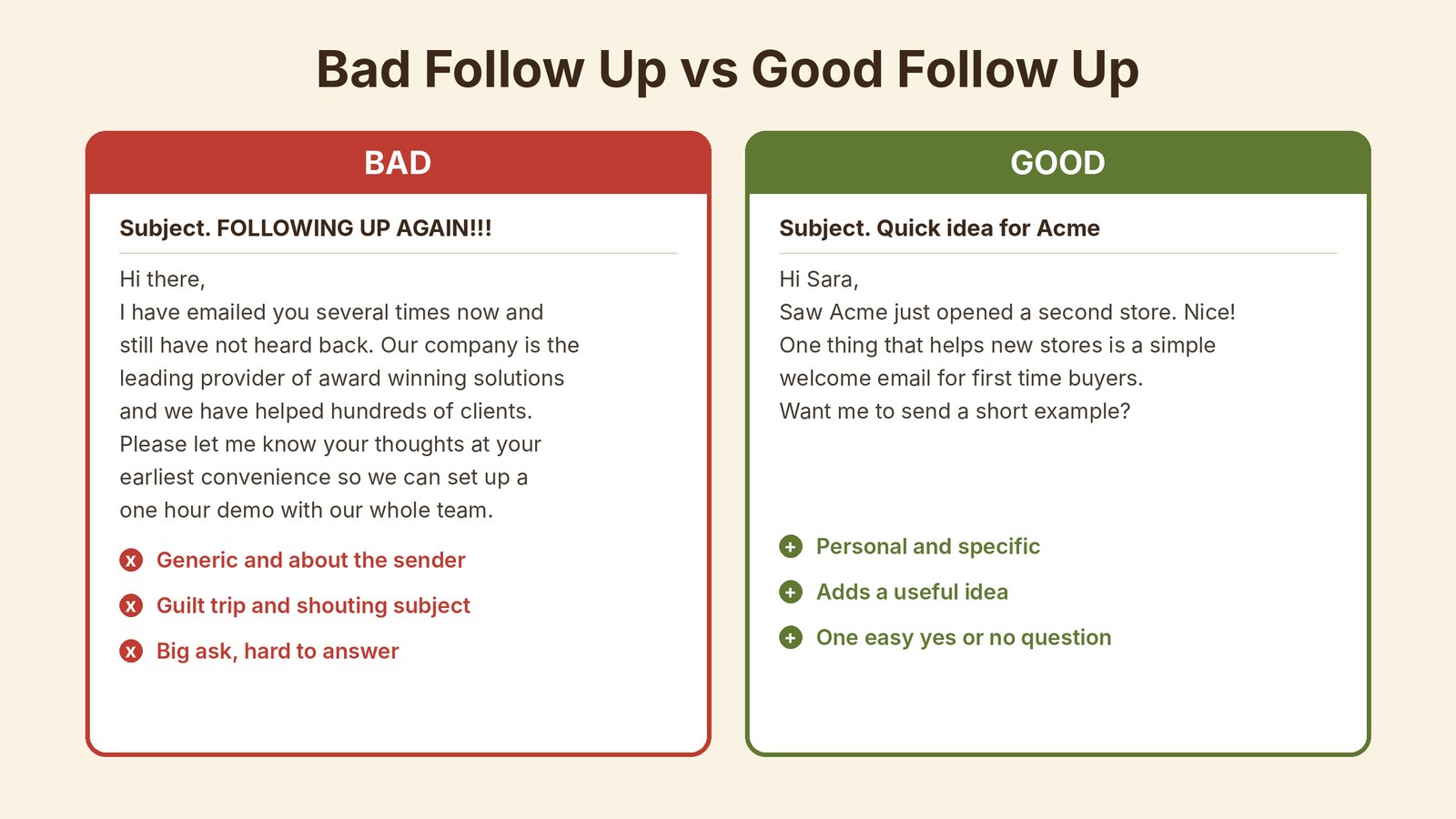
The bad version talks about you, guilt trips the reader and asks for too much. The good version is short, personal and makes replying easy.
Subject Lines That Get Opened
For follow ups, the simplest move is replying in the same thread so your original subject shows "Re" in front. If you do write a new one, keep it short and lowercase-friendly.
- "Quick idea for {Company}"
- "{Name}, worth a look?"
- "Right person?"
- "Saw your post on {topic}"
- "Should I close your file?"
Avoid all caps, lots of punctuation and spammy words like "free," "guarantee" or "act now."
Mistakes That Kill Your Reply Rate
- Sending the same text to everyone. Email providers notice repeated messages and push them to spam.
- Mailing bad addresses. Bounces hurt your sender reputation fast. Verify your list first.
- Following up too fast. Two emails in two days feels pushy.
- Missing a reply. If a prospect answers and your sequence keeps sending, you look careless.
- Long, salesy emails. Nobody reads a wall of text from a stranger.
How to Automate Your Follow Ups With Outrich
Writing and tracking follow ups by hand works for ten leads. It falls apart at a hundred.
Outrich is an AI email outreach platform that runs the whole sequence for you. Here's how it handles each part.
- Load your leads. Upload your list and let Outrich verify every address, so you don't hit dead mailboxes or spam traps.
- Enrich with AI. Outrich researches each prospect and writes a personal icebreaker that shows you did your homework.
- Build your sequence. Set up your first email, value-add reminders and a break-up email, with the delays you want between them.
- Make every email unique. The AI rewrites your message for each lead, with spintax on top, so no two emails are the same. That helps you land in the inbox.
- Let AI handle the replies. Outrich reads your inboxes, spots interested prospects and drafts replies using your FAQs and business details. You get notified when a hot lead responds.
- Run as many campaigns as you want. Test different offers or niches side by side.
It works for any business that sells by email, from agencies and SaaS to recruiting, consulting and web design.
Outrich costs $5.58 a month, paid yearly ($67 a year), or $17 month to month, with a 30 day refund. That's far less than hiring someone to write and track follow ups all day.
What to Do When Someone Replies
Getting the reply is only half the job. How you answer decides whether it turns into a meeting.
Reply fast. Interest cools quickly. Answering within an hour or two makes a big difference.
Answer the exact question. If they ask about price, give a clear range. Don't dodge it with another sales pitch.
Offer two time slots or a calendar link so booking takes one click.
Handle "not now" gracefully. Ask when a better time would be, then set a reminder and follow up then.
Outrich helps here too. It flags positive replies and drafts a response from your FAQs, so hot leads never sit waiting.
How to Track What's Working
Look at your numbers every week and change one thing at a time.
Replies per email step. If follow up 2 gets more replies than follow up 1, study what's different and use it elsewhere.
Positive replies. Raw replies include "no thanks." Count the interested ones separately.
Bounces and spam complaints. If these rise, clean your list and soften your wording.
Meetings booked. In the end, this is the number that pays the bills. A sequence with fewer replies but more meetings is the better one.
Frequently Asked Questions
How long should I wait before following up on a cold email?
Two to three business days is a good first gap. After that, space follow ups about a week apart.
How many follow ups is too many?
For most B2B outreach, more than five follow ups to the same person starts to feel pushy. End with a polite break-up email.
Should I follow up in the same thread?
Usually yes. It keeps the context and makes the email feel like a real conversation.
What if they say no?
Thank them, stop the sequence and ask if you can check back in a few months. A polite no today can turn into a yes later.
Is it okay to follow up on LinkedIn too?
Yes, as long as it's gentle. A short connection note that mentions your email can help your name stick, but don't repeat the same pitch on every channel.
Can AI write follow ups that sound human?
Yes, when it's given real details about the prospect. Outrich enriches each lead first, so its emails reference real context instead of generic filler.
Final Thoughts
Most cold email deals aren't won in the first message. They're won by people who follow up politely, add value and know when to stop.
Use the timing and templates above, and you'll start seeing replies from people who would have stayed silent. Start with one small sequence this week, watch the results and keep improving one email at a time.
Want the whole sequence on autopilot? Try Outrich. It enriches, writes, follows up and even drafts replies for you, starting at $5.58 a month, paid yearly.